Wally Mixtures
About this build
Ben and Becky make oversized jelly and fondant sweets, including a sugared bear, a layered sweet and a rolled Dolly Mixture.
Archive summary updated
Read the original account and photographs ↓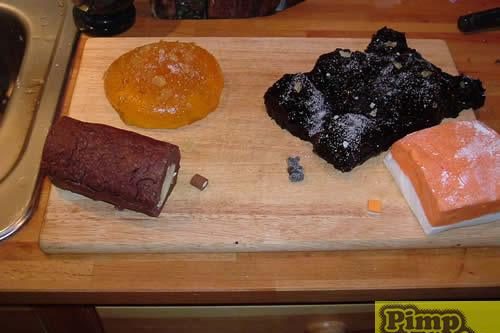
What the original account establishes
These notes distinguish the recorded result from quantities or settings the contributor did not specify. Follow each source link to the original passage.
- The four common Dolly Mixture types were identified as the roll-up, the sandwich, the jelly tot and the jelly bear, and the total estimated cost was about £10 after a failed first jelly needed more packets and gelatine. The sweets measured between 11 and 25mm, so everything was scaled up ten times to 11 to 25cm, with a baking tin and an ice-cream maker as jelly moulds. Double-strength jelly would not make a bear, so octuple-strength jelly with a couple of sachets of gelatine and black colouring was set for three hours into a rubbery mass that stuck to everything, and thirty minutes of carving left ugly black fragments. The scaled-up sugar coating was 8oz of sugar boiled for a couple of minutes with a couple of fluid ounces of water and the juice of a lemon, cooled, broken up with a rolling pin that did not survive, and stuck on with very hot water. The sandwich was two egg whites, 24oz of icing sugar and a little cornflour at 11cm square, with orange essence and red and yellow colouring in the orange layer; the roll-up used 5oz of butter, 300g of condensed milk and 24oz of icing sugar, with an ounce of cocoa in the outer layer and more condensed milk if it cracks. The lessons: never sculpt jelly, do not make moulds from plasticine, and use a metal spoon with black colouring. Source 1 · Source 2 · Source 3 · Source 4 · Source 5 · Source 6 · Source 7 · Source 8 · Source 9
Notes from the contributor
Selected passages from the original account. Quantities may describe shopping, tests or the final build; follow the linked passage for its full context.
Some extra ingredients were necessary after a failed attempt at recreating the ‘hard’ jelly, including lots more jelly packets and some gelatine (it’s made out of cow’s hooves, you know). Total estimated cost: about £10.
Read in context →
Initial measurements showed that dolly mixtures were between 11 and 25mm in size. We decided to scale them up by ten, which meant our final products would be between 11 and 25cm. The paste products were easy to manipulate to the right size, but of course jelly needs a mould. A baking tin and our ice-cream maker were quickly pressed into service as receptacles of the right type.
Read in context →
Archive guides · Explore projects
The original account
We decided to do our first pimp before the idea became widespread and famous on The F Word. After a suggestion on the forums, we thought Becky’s favourite Dolly Mixtures would be an inspired choice. It was quickly noted that the composition of Dolly Mixtures varies widely from manufacturer to manufacturer, and the four common elements were the ‘roll-up’ type, the ‘sandwich’ type, the ‘jelly tot’ and the ‘jelly bear’. Becky had a good recipe for paste, I thought I could make jelly (oh, misplaced confidence), and we quickly went shopping.

Some extra ingredients were necessary after a failed attempt at recreating the ‘hard’ jelly, including lots more jelly packets and some gelatine (it’s made out of cow’s hooves, you know). Total estimated cost: about £10.


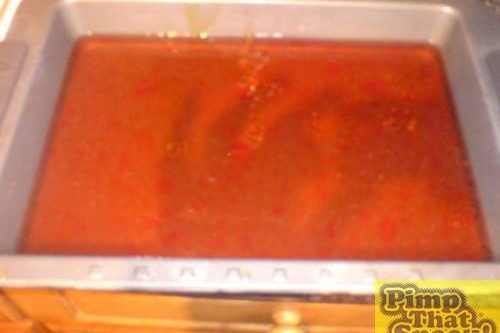
Initial measurements showed that dolly mixtures were between 11 and 25mm in size. We decided to scale them up by ten, which meant our final products would be between 11 and 25cm. The paste products were easy to manipulate to the right size, but of course jelly needs a mould. A baking tin and our ice-cream maker were quickly pressed into service as receptacles of the right type.

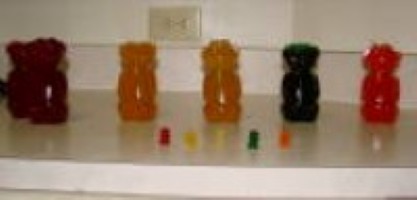
Initial experiments showed the double-strength jelly did not take kindly to attempts to make into a teddy bear, so we drastically upped the recipe and made octuple-strength jelly, with a couple of sachets of gelatine for good measure. A generous dash of black food colouring simultaneously added authenticity and made a right mess of much of our kitchen.

Three hours in the fridge later (that’s the jelly, not me) and we had produced a rubber-like substance that stuck to everything and quickly became known as Jelly Of The Devil. Bravely, I sharpened my kitchen knives and began work on possibly the world’s first bit of jelly sculpture. Thirty frustrating minutes later, I gathered why Michaelangelo and Henry Moore had chosen stone or bronze as a medium, and had one almighty mess of ugly black jelly fragments.


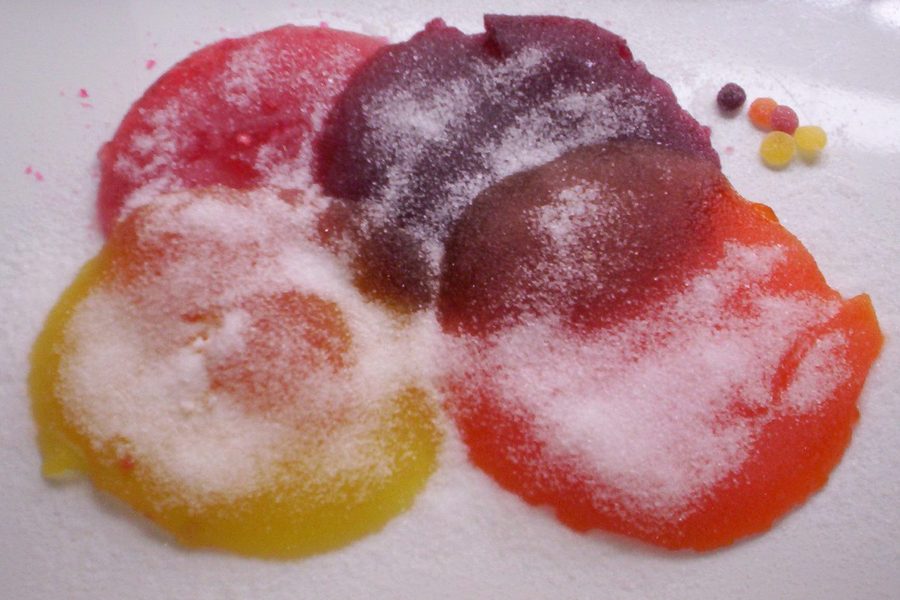
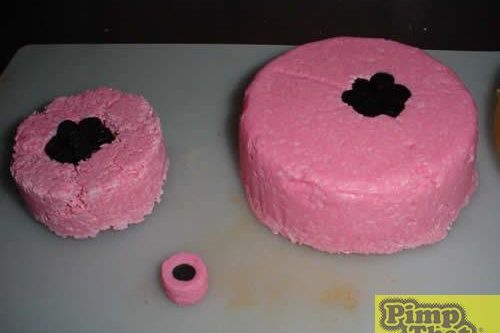
The coup de gras (the French for lawnmower, so I’m led to believe) was the sugar coating. A more unimaginative soul might have sprinkled granulated sugar over the jelly products, but no! We had to scale-up our sugar too. 8oz of sugar went into a pan, along with a couple of fluid ounces of water and the juice of a lemon (for that citric acid ‘tang’). Boil vigorously for a couple of minutes and pour out and allow to cool. Some hefty work with a rolling pin (now sadly damaged beyond repair and the only lasting victim of this pimp apart from the person who decides to eat it), and you have scaled-up sugar granules. Sprinkle liberally, and a light coating of very hot water helps to both stick the sugar, and smooth off some of my knifemarks.
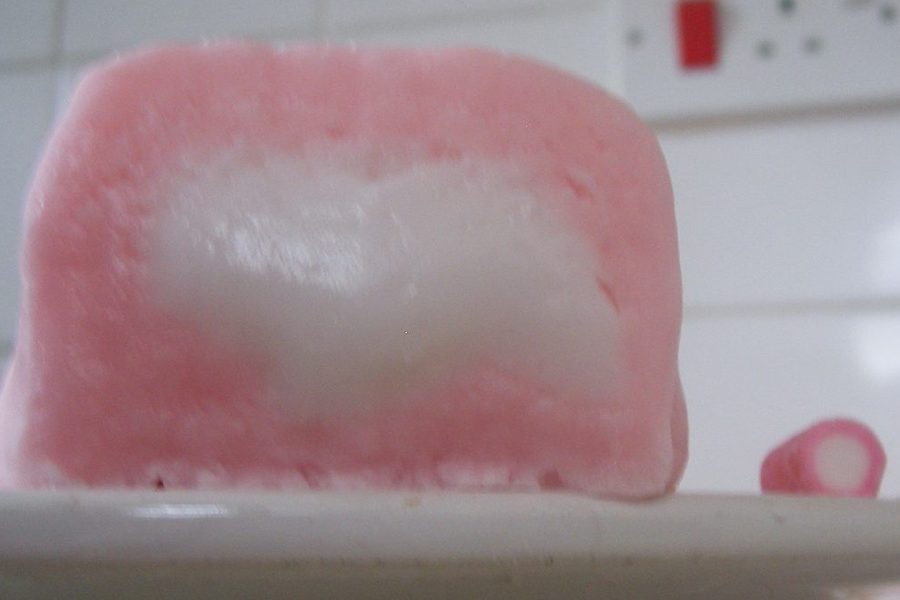
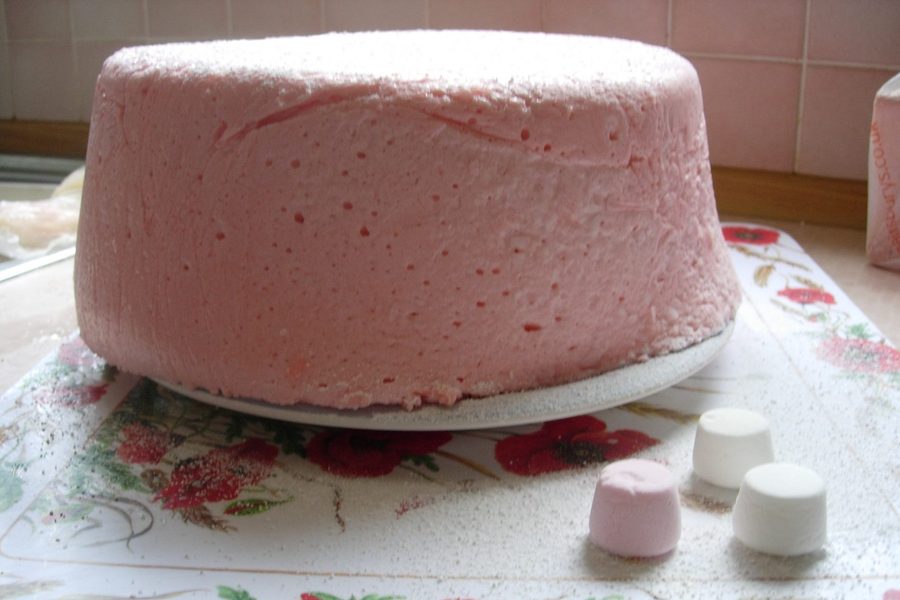
The paste items were easier. The sandwich came first and was carefully scaled up to 11cm squared. Two egg whites with 24oz of icing sugar, a little cornflour and mixed well. The orange layer was spiced up with a dash each of orange essence, red food colouring and yellow food colouring.


Phat
The roll-up proved a little more tricky, because the paste recipe didn’t take kindly to being rolled into a circle. This one used 5oz of butter, 300g of condensed milk and 24oz of icing sugar to make it more malleable. The outside layer had an ounce of cocoa added. Add more condensed milk if it starts to crack. Perhaps not quite the authentic recipe, but then Rowntrees don’t have to make one that big!

Lessons learned:
1) Don’t ever, ever try to mould or sculpt anything out of jelly! Leave it to the professionals.
2) Don’t try to make moulds out of plastecine.
3) Black food colouring is the very devil to get out of a wooden spoon. Use metal.
The final product: not bad for our first pimp, but we’re sure we can do better!