Bukabuka Makizushi
About this build
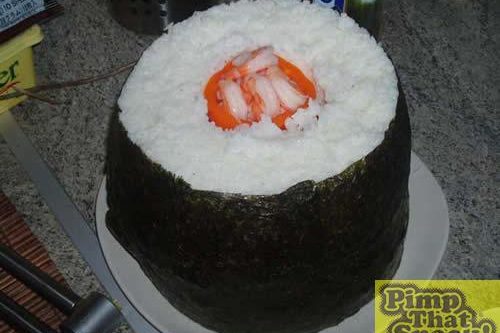
A giant maki-style sushi roll shaped in a loose-bottomed tin, with nori, sushi rice, tinned tuna and strips of pepper.
Archive summary updated
Read the original account and photographs ↓
Notes from the contributor
Selected passages from the original account. Quantities may describe shopping, tests or the final build; follow the linked passage for its full context.
3 nori (seaweed) sheets – £1.13 for 10 sheets about 500g nishiki (sushi) rice – £1.97 per kg 2 tins of tuna in oil – £1.99 for 4 2 peppers (1 red, 1 green) – £1.29 for 3
Read in context →
Also needed: Loose bottom cake tin Glass Saucepan Spoons Sharp knife
Read in context →
Bukabuka Makizushi: the archived recipe
Condensed from the original account by Chloe ‘Pesky’ McGenn, published 2006-04-17. The quantities and method are the contributor’s; this is not a new kitchen test.
Ingredients recorded
- 3 nori (seaweed) sheets
- About 500g nishiki (sushi) rice
- 2 tins of tuna in oil
- 2 peppers (1 red, 1 green)
- A loose-bottomed cake tin, a glass, a saucepan, spoons and a sharp knife
The account prices the nori at £1.13 for 10 sheets, the rice at £1.97 per kg, the tuna at £1.99 for 4 tins and the peppers at £1.29 for 3; the tuna tin size is not given and is not legible in the ingredient photograph. The rice is given as about 500g.
Method recorded
- Cook the rice, watching it because nishiki rice boils dry: 20 minutes, then turn off the heat, cover and leave for 10 minutes. Let it cool before assembling; the contributor did not, and paid for it later.
- Cut the nori sheets into strips and line the inside of the cake-tin ring, standing the ring without its base on a chopping board.
- Place the glass somewhere in the middle of the ring; the rice will be pressed around it and the hole filled later.
- Open the tuna tins, drain the excess oil and break the chunks up in a bowl. Cut the peppers into strips for the middle.
- Pack the rice between the tin and the glass without moving the glass or the nori, press it down tight and refrigerate to cool and set, about thirty minutes.
- Ease out the glass and stuff the hole with tuna: half fill it, make a gap, stand pepper sticks of the right length in the gap and pile tuna round them, cut ends uppermost.
- Lift off the ring; if the rice was hot, the nori against the metal will have frazzled, and can be patched with more strips, which stick better while the rice is warm.
Archive guides · Explore projects
The original account
Maki is the name for those little sushi rolls which come in all those little boxes from supermarkets. Got the idea for this when playing We Love Katamari – there’s a level where you roll a sumo wrestler around the streets picking up giant pieces of sushi to build him up for the fight… and if that doesn’t make you want to play that game, I don’t know what will.

Ingredients
3 nori (seaweed) sheets – £1.13 for 10 sheets
about 500g nishiki (sushi) rice – £1.97 per kg
2 tins of tuna in oil – £1.99 for 4
2 peppers (1 red, 1 green) – £1.29 for 3
Also needed:
Loose bottom cake tin
Glass
Saucepan
Spoons
Sharp knife
1. First you need to cook your rice. Now, I find Nishiki rice a pain in the neck, cause it always boils dry. Of course that could be me getting sidetracked, but I choose to blame the rice. Keep your eye on it. It needs 20 minutes, then turn off the heat, cover with a lid, and leave for 10 minutes.
2. The most vital component of the Huge Maki to differentiate it from a big pile of rice is, of course, the seaweed. I decided to cut the nori sheet into strips, and line the inside of the cake tin. I chose not to use the bottom of the cake tin, but instead placed the circular metal thing on a chopping board.


3. Once the nori is lining the tin, place the glass somewhere in the middle. In usual sushi making, you roll it into a big log, but for this huge sushi, we’d need a nori sheet the size of a duvet cover, and arms like Popeye, so we’ll leave a hole to stuff the fish in instead.
4. There’s no raw fish in this maki, partly because that’s how I always make it, and partly because I’m not stuffing raw fish into anything for anyone. Basically, you just open the two tins, drain off the excess oil, and break the chunks up in a bowl.
5. For that authentic sushi look, I also decided to chop some peppers into strips for stuffing down the middle of the fish.

6. After the ten minutes were up, I decided to make the sushi straight away. I got over excited. If you’re planning to recreate, please leave the rice to cool as we shall see later…
7. The knack here is getting the rice between the cake tin and the glass without disturbing the position of the glass or nori. Being a clumsy git, I ended up cleaning it up afterwards.

8. Once the rice is pressed down nice and tight, you can put it in the fridge to cool and set.
9. Thirty minutes, or in my case about thirty seconds, later, you can ease out the glass, and stuff the innards with the tuna.

10. To get the peppers standing upright, half fill the hole with tuna, make a gap in the middle of this, make sure the pepper sticks are the right length, and shove them into the new gap. Then keep on piling tuna around them until it looks right. Perfectionists amongst you might want to make sure none of the tuna spoils the whiteness of the rice, and that the cut end of the pepper is uppermost to give the illusion of being cut from a roll.
11. Now to get the whole thing out of the tin, and here’s where it starts to go wrong. A combination of the rice being too hot, due to my impatience, and the presence of a metal ring, which conducts heat very well, have conspired to frazzle the nori sandwiched between the ring and the rice.

12. Never mind, we’ll just repair it with a few more nori sheets cut into strips. The rice is STILL a bit hot, which definitely helps the nori to stick to the outside.
13. And there we have it! To serve you’ll need 2 garden canes to use as chopsticks, the largest bottle of soy sauce you can find, and an A4 sized piece of pickled ginger to rest on the top. Wassaaaaabi!